
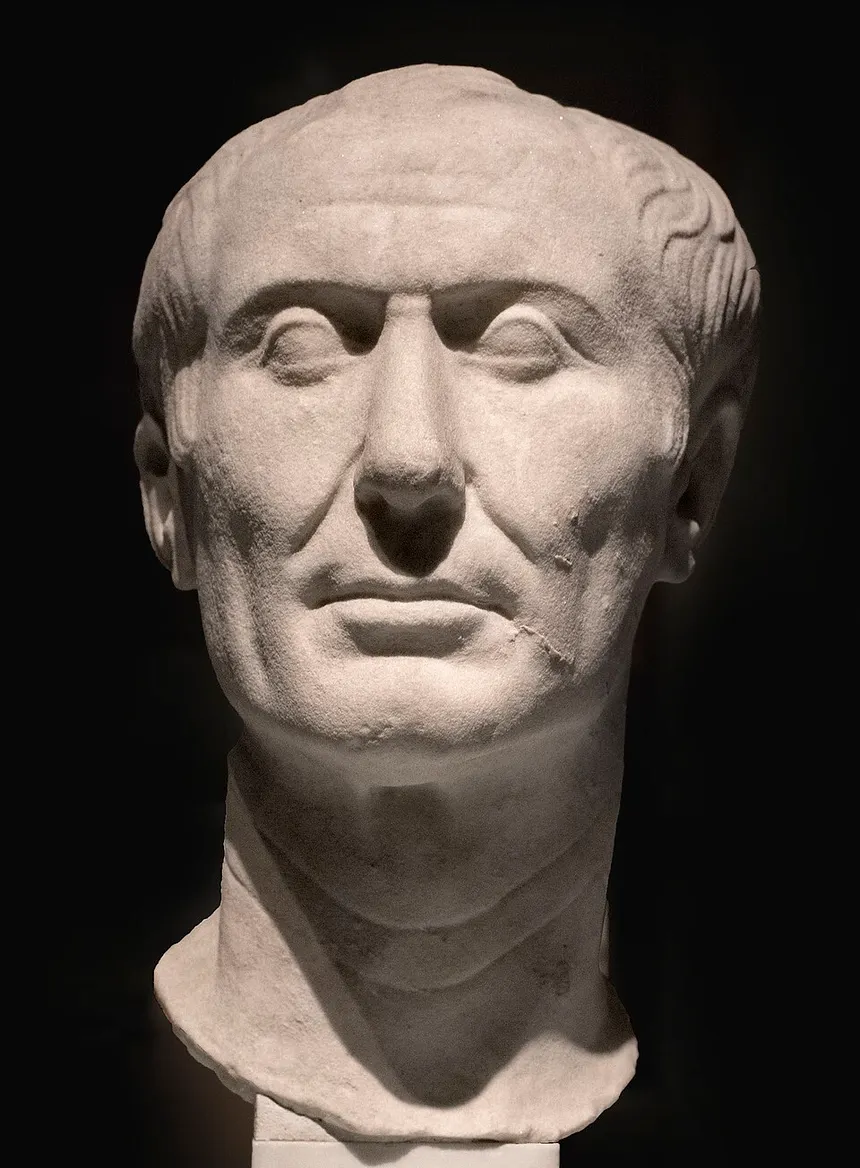
Gaius Julius Caesar
Also known as: Julius Caesar · Caesar
Roman Dictator - General - Consul
Map
Timeline
Born in Rome
Born into the distinguished Julian clan in Rome.
Targeted by Sulla
Refused to divorce his wife Cornelia at Sulla's command, was placed on a list of enemies, and left Rome until Sulla's death.
Pontifex Maximus
Elected to the highest priestly office in Rome, cementing his political ascent.
First Triumvirate
Formed a political alliance with Pompey and Crassus, dominating Roman politics.
Gallic Wars Begin
Launched the conquest of Gaul, adding vast territories and wealth to Rome.
Battle of Bibracte
Gaul (France) - vs Helvetii tribe - Secured Caesar's first major victory and established his authority in Gaul.
Battle of Alesia
Alesia, Gaul - vs Vercingetorix / Gauls - Decisive end of the Gallic Wars; captured the Gallic chieftain Vercingetorix.
Crossed the Rubicon
Crossed the boundary into Italy with his army, triggering civil war.
Battle of Pharsalus
Decisively defeated Pompey; met Cleopatra VII in Egypt shortly after.
Battle of Dyrrachium
Dyrrachium (Albania) - vs Pompey the Great - Caesar's only major defeat; he was outmaneuvered but lived to fight again.
Battle of Pharsalus
Pharsalus, Greece - vs Pompey the Great - Turning point of the civil war; Pompey fled and was later assassinated in Egypt.
Battle of Zela
Pontus (Turkey) - vs Pharnaces II of Pontus - So swift that Caesar coined 'Veni, vidi, vici' in his dispatch to Rome.
Reformed the Calendar
Introduced the Julian calendar, a solar calendar of 365.25 days.
Battle of Thapsus
Thapsus (Tunisia) - vs Pompeian Senate forces - Ended Republican resistance in North Africa; Cato the Younger committed suicide.
Assassinated
Murdered on the Ides of March by a group of senators including Brutus and Cassius.
Family Tree
Parents
Gaius Julius Caesar
Father
c. 130-85 BC
Aurelia Cotta
Mother
c. 120-54 BC
Subject & Siblings
Julius Caesar
Self
100 BC - 44 BC
Spouses
Cornelia
Wife I
c. 97-69 BC
Pompeia
Wife II
fl. 82-62 BC
Calpurnia
Wife III
c. 70-after 44 BC
Children
Julia Caesaris
Daughter
76-54 BC
Caesarion
Son
47-30 BC
Key Contributions
-
Sword Gallic Wars
8-year campaign conquering all of modern-day France and Belgium.
-
Calendar Julian Calendar
Introduced the 365-day solar calendar, basis of our modern Gregorian calendar.
-
Landmark Political Reform
Extended Roman citizenship, reformed the senate, and centralized power.
-
Scroll Literary Works
Authored Commentarii de Bello Gallico, a first-hand account of the Gallic Wars.
Fun Facts
Skull
Kidnapped by Pirates
Caesar was captured by Cilician pirates in 75 BC. He joked that he would crucify them when freed, and then did exactly that.
Scissors
Deeply Vain About Hair
Caesar was self-conscious about his baldness. He combed his hair forward and used his laurel wreath to hide it.
Brain
Suffered from Epilepsy
Ancient sources describe Caesar having seizures, referred to as the falling sickness.
PenLine
Prolific Author in War
Caesar wrote his Gallic War commentaries while actively commanding in the field.
Assassination
Location
Location: Theatre of Pompey, Rome
Burial: Forum Romanum, Rome
Conspirators
-
Marcus Junius Brutus
Moral figurehead whose participation legitimized the act as tyrannicide rather than murder.
Impact
Caesar's assassination ignited 13 more years of civil war. Brutus and Cassius were defeated at Philippi (42 BC). Octavian ultimately defeated Mark Antony and Cleopatra at Actium (31 BC) and became Augustus — the first Roman Emperor — establishing the very autocracy the conspirators had sought to prevent.
See Also
Other Figures
Related Sites
"Veni, vidi, vici."
After the Battle of Zela, 47 BC