
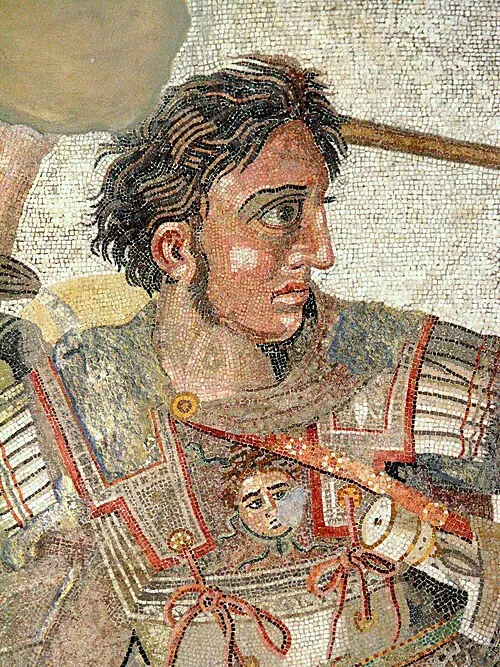
Alexander the Great
Also known as: Alexander III of Macedon · Iskandar
King of Macedon - General - Conqueror
Map
Timeline
Born in Pella
Born to King Philip II of Macedon and Olympias of Epirus in the royal capital of Pella.
Tutored by Aristotle
Philip II invited Aristotle to tutor the young Alexander, who studied philosophy, medicine, science, and rhetoric at the school of Mieza.
Battle of Chaeronea
At just 18, Alexander commanded the Macedonian left wing and led the decisive charge that crushed the Sacred Band of Thebes, securing Macedonian dominance over Greece.
Battle of Chaeronea
Chaeronea, Boeotia - vs Athens and Thebes - Established Macedonian hegemony over all of Greece; Alexander personally destroyed the elite Sacred Band of Thebes.
Becomes King of Macedon
After the assassination of Philip II, Alexander claimed the throne at age 20 and swiftly suppressed rebellions across Greece and the Balkans.
Invasion of Persia
Crossed the Hellespont into Asia with an army of 40,000 men, visiting Troy before winning his first major victory at the Granicus River.
Battle of the Granicus
Granicus River, Asia Minor - vs Persian satraps - Alexander's first victory on Persian soil, opening Asia Minor to his advance.
Battle of Issus
Routed the Persian army of Darius III despite being outnumbered; Darius fled the battlefield, leaving his family behind.
Battle of Issus
Issus, Cilicia - vs Darius III - Routed Darius III's numerically superior army; the Persian king fled, abandoning his family to Alexander.
Siege of Tyre
Tyre, Phoenicia - vs Tyre - Seven-month siege of an island fortress; Alexander built a causeway to breach it, one of the greatest engineering feats of the ancient world.
Founds Alexandria & Defeats Darius at Gaugamela
Founded the city of Alexandria in Egypt and then utterly defeated Darius III at Gaugamela, effectively ending the Achaemenid Persian Empire.
Battle of Gaugamela
Gaugamela, Assyria - vs Darius III - The decisive battle of the Persian campaign; Darius III fled and was later murdered by his own satraps, ending the Achaemenid Empire.
Burns Persepolis
Captured and burned the Persian ceremonial capital of Persepolis, avenging the Persian destruction of Athens in 480 BC.
Marries Roxana & Enters India
Married the Bactrian princess Roxana and led his army through the Khyber Pass into the Indian subcontinent.
Battle of the Hydaspes
Defeated the Indian king Porus at the Hydaspes River in a tactically brilliant battle. His army then refused to march further east.
Battle of the Hydaspes
Hydaspes River, Punjab - vs King Porus of Paurava - Alexander's last and arguably most tactically impressive victory, defeating war elephants with a brilliantly executed night crossing.
Dies in Babylon
Died in the palace of Nebuchadnezzar II in Babylon at age 32, possibly of typhoid fever complicated by his battle wounds. His vast empire was divided among his generals.
Family Tree
Parents
Philip II of Macedon
Father
382-336 BC
Olympias of Epirus
Mother
c. 375-316 BC
Subject & Siblings
Alexander the Great
Self
356 BC - 323 BC
Cleopatra of Macedon
Sister
c. 355-308 BC
Philip III Arrhidaeus
Half-brother
c. 359-317 BC
Spouses
Roxana
Wife I
c. 340-310 BC
Stateira II
Wife II
died 323 BC
Children
Alexander IV
Son
323-309 BC
Key Contributions
-
Sword Undefeated General
Never lost a battle in 15 years of continuous warfare, conquering an empire stretching from Greece to northwestern India.
-
Scroll Student of Aristotle
Educated by the greatest philosopher of antiquity, instilling a love of science, philosophy, and medicine.
-
Landmark Hellenistic Spread
Spread Greek language and culture across the Middle East and Central Asia, reshaping civilization for centuries.
-
Map Founded Alexandria
Founded over 20 cities bearing his name, most notably Alexandria in Egypt, which became the greatest city of the ancient world.
Fun Facts
Horse
Bucephalus
Alexander tamed the wild horse Bucephalus at age 12 when no adult could. The horse carried him through most of his campaigns; when Bucephalus died in India, Alexander founded a city named Bucephala in his honor.
Scroll
Slept with the Iliad
Alexander kept a copy of Homer's Iliad — annotated by Aristotle — under his pillow alongside a dagger, modelling himself on the hero Achilles.
City
Named 20+ Cities After Himself
Alexander founded or renamed over 20 cities 'Alexandria' across his empire, from Egypt to Afghanistan, as living monuments to his conquest.
Health
Died at 32
Despite conquering half the known world, Alexander died at just 32 in Babylon. His cause of death remains debated — typhoid fever, excessive drinking, and poisoning are all proposed.
Disputed — typhoid fever, poisoning, or alcoholism
Location
Location: Palace of Nebuchadnezzar II, Babylon
Burial: Alexandria, Egypt
Those Involved
-
Perdiccas
Senior general who received Alexander's signet ring and initially acted as regent over the empire.
Impact
Alexander's death without a clear, capable adult heir triggered the Wars of the Diadochi, fragmenting his empire into rival Hellenistic kingdoms — the Ptolemaic Kingdom in Egypt, the Seleucid Empire in the east, and the Antigonid dynasty in Macedon — that reshaped the ancient world for the next three centuries.
See Also
Other Figures
Related Sites
"There is nothing impossible to him who will try."
Attributed to Alexander the Great