
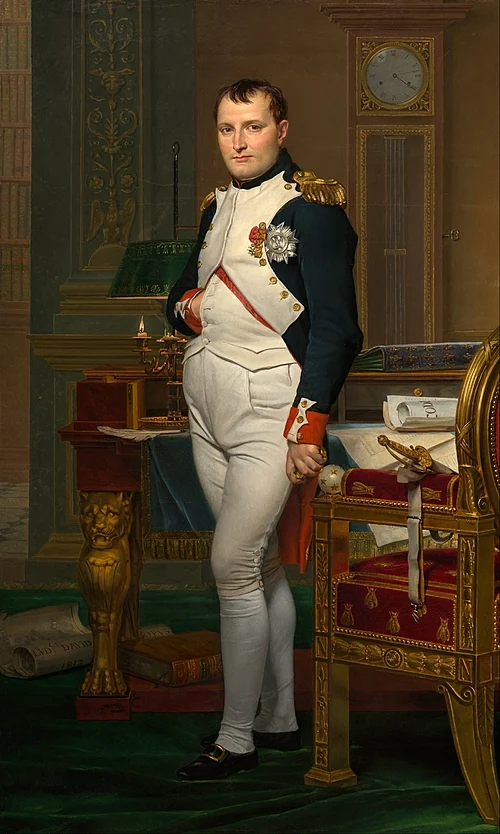
Napoleon Bonaparte
Also known as: Napoleon · Napoleon I · The Little Corporal · L'Empereur
Emperor of the French - General - Conqueror
Map
Timeline
Born in Ajaccio
Born in Ajaccio, Corsica, just one year after France acquired the island from Genoa.
Commissioned as Artillery Officer
Graduated from the École Militaire in Paris and was commissioned as a second lieutenant in the artillery.
Italian Campaign
Took command of the Army of Italy, winning a series of rapid victories against Austria and Piedmont.
Coup of 18 Brumaire
Seized power in a coup, becoming First Consul and effectively ruler of France.
Battle of Marengo
Marengo, Italy - vs Austria - Secured French control of northern Italy and cemented Napoleon's political position as First Consul.
Crowned Emperor
Crowned himself Emperor of the French at Notre-Dame Cathedral in the presence of Pope Pius VII.
Battle of Austerlitz
Defeated the combined Austrian and Russian armies in arguably his greatest tactical victory.
Battle of Austerlitz
Austerlitz, Moravia - vs Austria & Russia - Napoleon's tactical masterpiece; forced Austria out of the war and dissolved the Holy Roman Empire.
Battle of Jena
Jena, Prussia - vs Prussia - Crushed the Prussian army in a single day, leading to the occupation of Berlin.
Invasion of Russia
Led the Grande Armée of over 600,000 men into Russia; the catastrophic retreat destroyed his army.
Battle of Borodino
Borodino, Russia - vs Russia - Bloodiest day of the Napoleonic Wars; Napoleon captured Moscow but failed to force Russian surrender.
Battle of Leipzig
Leipzig, Germany - vs Austria, Prussia, Russia, Sweden - The "Battle of Nations" — Napoleon's largest defeat; forced his retreat to France.
First Abdication
Forced to abdicate after allied forces entered Paris; exiled to the island of Elba.
Hundred Days & Waterloo
Escaped Elba and briefly reclaimed power before his final defeat at Waterloo. Exiled to Saint Helena.
Battle of Waterloo
Waterloo, Belgium - vs Britain & Prussia - Napoleon's final defeat, ending the Hundred Days and leading to permanent exile on Saint Helena.
Death on Saint Helena
Died on the remote island of Saint Helena in the South Atlantic, aged 51.
Family Tree
Parents
Carlo Buonaparte
Father
1746–1785
Letizia Ramolino
Mother
1750–1836
Subject & Siblings
Napoleon
Self
1769 - 1821
Spouses
Joséphine de Beauharnais
Wife I
1763–1814
Marie-Louise of Austria
Wife II
1791–1847
Children
Napoleon II
Son
1811–1832
Key Contributions
-
Sword Military Genius
Revolutionized warfare with rapid maneuver, corps system, and decisive offensive strategy.
-
Scroll Napoleonic Code
Civil law code of 1804 that formed the basis of legal systems in France and many other countries.
-
Crown Emperor of the French
Transformed the French Republic into an empire and dominated European politics for over a decade.
-
Map Reshaping Europe
Redrew the map of Europe, abolished the Holy Roman Empire, and spread revolutionary ideals across the continent.
Fun Facts
Ruler
The Height Myth
Napoleon was actually about 5'7" (170 cm) — average for his era. The myth arose partly from British caricatures and confusion between French and English inch measurements.
Grid
Terrible Chess Player
Napoleon loved chess but was reportedly a poor player who often demanded rematches when he lost.
Cat
Feared Cats
Napoleon was reportedly ailurophobic — he had an intense fear of cats, an unusual trait for a fearless battlefield commander.
PenLine
Published a Novel
Napoleon wrote a short romantic novella, Clisson et Eugénie, at age 26, before his rise to power.
Stomach cancer (arsenic poisoning also theorized)
Location
Location: Longwood House, Saint Helena
Burial: Les Invalides, Paris, France
Those Involved
-
General Henri Bertrand
Loyal companion who remained with Napoleon throughout his Saint Helena exile.
Impact
Napoleon's death sparked an immediate legend. The "Napoleonic myth" grew throughout the 19th century, influencing art, literature, and politics across Europe. His nephew Louis-Napoleon Bonaparte later became Napoleon III, Emperor of the French.
See Also
Other Figures
Related Events
"Impossible is a word found only in the dictionary of fools."
Attributed, c. 1800s